
Buying a New Building Without Illusions: 6 Major Legal Traps in Developer Contracts and European Experience in Investor Protection
Buying an apartment in a new development is always an emotional milestone. In your dreams, you are already arranging furniture, choosing wall colors for the bedroom, and planning your ideal kitchen. However, as the renovation company “RSU”, we come back to reality every day when entering real construction sites. Unfortunately, we regularly see how the joy of buying an apartment fades right at the stage of signing agreements with developers.
It is a mistake to think that a contract with a developer is merely a formal piece of paper for the sales department. In practice, this document determines whether you will receive your apartment on time, whether you will be forced to pay thousands of dollars extra for no reason, and what will happen to your savings in the event of an unexpected emergency.
We have carefully read and analyzed dozens of real contracts from major Ukrainian developers and Housing Construction Cooperatives (HCC). In this article, we break down in detail which critical points you need to pay attention to BEFORE making your first deposit, and at the end, we will show how these exact processes are regulated in Europe.
Part 1. Financial Force Majeure: What Happens If You Cannot Pay Your Installments?
Today's reality makes planning income 2–3 years ahead extremely difficult. Job loss, relocation, business risks, or family circumstances can lead to a situation where paying the next installment becomes impossible.
Most buyers blindly believe: “Well, if something happens, I’ll just terminate the contract and get my money back.” This is the primary and most dangerous misconception! Let’s look at how developers insure themselves against your potential insolvency.
1. Draconian Fines for Contract Termination (up to 15% of the Total Price)
If you can no longer pay the installments or decide to walk away from the purchase, the developer will not simply take back the apartment—they will impose severe financial penalties on you.
- How it is hidden in contracts: Almost every document contains a penalty clause for early contract termination initiated by the buyer (or due to payment delays exceeding 30 days). The amount of this penalty is usually between 10% and 15%.
- Where the trap lies: Pay attention to what amount the percentage is calculated from! Often, the penalty is calculated not from the money you have actually paid so far, but from the TOTAL FULL PRICE OF THE APARTMENT!
- Real-life example: You bought an apartment for $50,000 in installments. You managed to pay only the initial installment of $15,000. Due to unforeseen life circumstances, you realize you cannot continue making payments. You come to terminate the contract, expecting to receive your $15,000 back. However, the developer applies a clause for a penalty of 10–15% on the total price of the property. As a result, they withhold between $5,000 and $7,500! Meaning you lose up to half of all your actual hard-earned savings.
2. "Freezing" Funds for an Indefinite Period
Even the remaining money owed to you after deducting penalties is unlikely to be returned quickly.
- The resale trap: In 90% of agreements for the purchase of property rights or forward contracts, developers insert a clever phrasing: “Refund of funds to the Buyer shall be made within 10 business days AFTER the sale of this real estate property to a New Buyer and receipt of full payment from them.”
- What this means for you: The developer does not take money out of their own pocket to refund you. They list your apartment for sale and wait. If the market is stagnant, overpriced, or the property lacks demand, the apartment can sit on the market for 2, 3, or even 5 years. All that time, your money will legally remain with the developer, and you will not even be able to claim interest for the use of your funds (developers explicitly disengage statutory interest remedies in contract texts).
3. Daily Penalties and Unilateral Termination in 5 Days
If you simply delay a scheduled payment, the developer turns on the penalty counter.
- In standard contracts, late payment interest can range from 0.1% to 0.3% per day (which accumulates up to 110% annually!).
- In Housing Construction Cooperatives (HCC), conditions are even harsher: a payment delay of more than 5 banking days gives the cooperative the right to unilaterally expel you from the membership and repossess the apartment.
Part 2. Tricks with Apartment Area and BTI Measurements
When the building is completed, an engineer conducts a technical inventory (BTI measurements). The design area almost never 100% matches the actual built area—a wall shifted by a couple of centimeters, or plaster turned out slightly thicker or thinner, and suddenly you have 52 or 48 sq. m. instead of 50 sq. m.
This is where developers hide financial asymmetry, causing buyers to lose substantial amounts of money.
1. Exchange Rate Asymmetry in Extra Payments vs. Refunds
- If the apartment size increases: You are obligated to pay extra for the "additional" square meters. This extra payment is almost always calculated in USD (or local currency converted at the current, increased rate on the date of payment).
- If the apartment size decreases: The developer is obligated to refund you for the "missing" square meters. This is where legal tricks happen: your refund is calculated in local currency at the initial exchange rate established at the signing of the contract 2 years ago!
- Why this is unfair: Over those years, the national currency exchange rate could have dropped significantly, making the purchasing power of the refunded sum much lower than what you originally paid per meter.
2. Hidden Area Buffers in Cooperatives (Paying for Up to 5 Extra Meters!)
In some cooperative agreements, extra area payments are regulated using extremely vague phrasing.
- The developer writes: “The actual area may increase within 5 square meters, and the Participant agrees to pay for these meters within 15 days.”
- In practice, this means the developer reserves the legal right to "expand" your apartment by up to 5 whole square meters. If a square meter costs $1,000, right before receiving the keys you will face an ultimatum: urgently pay an extra $5,000 within two weeks, or you will not receive your documents.
Part 3. Project Revisions and Downgrading Building Quality
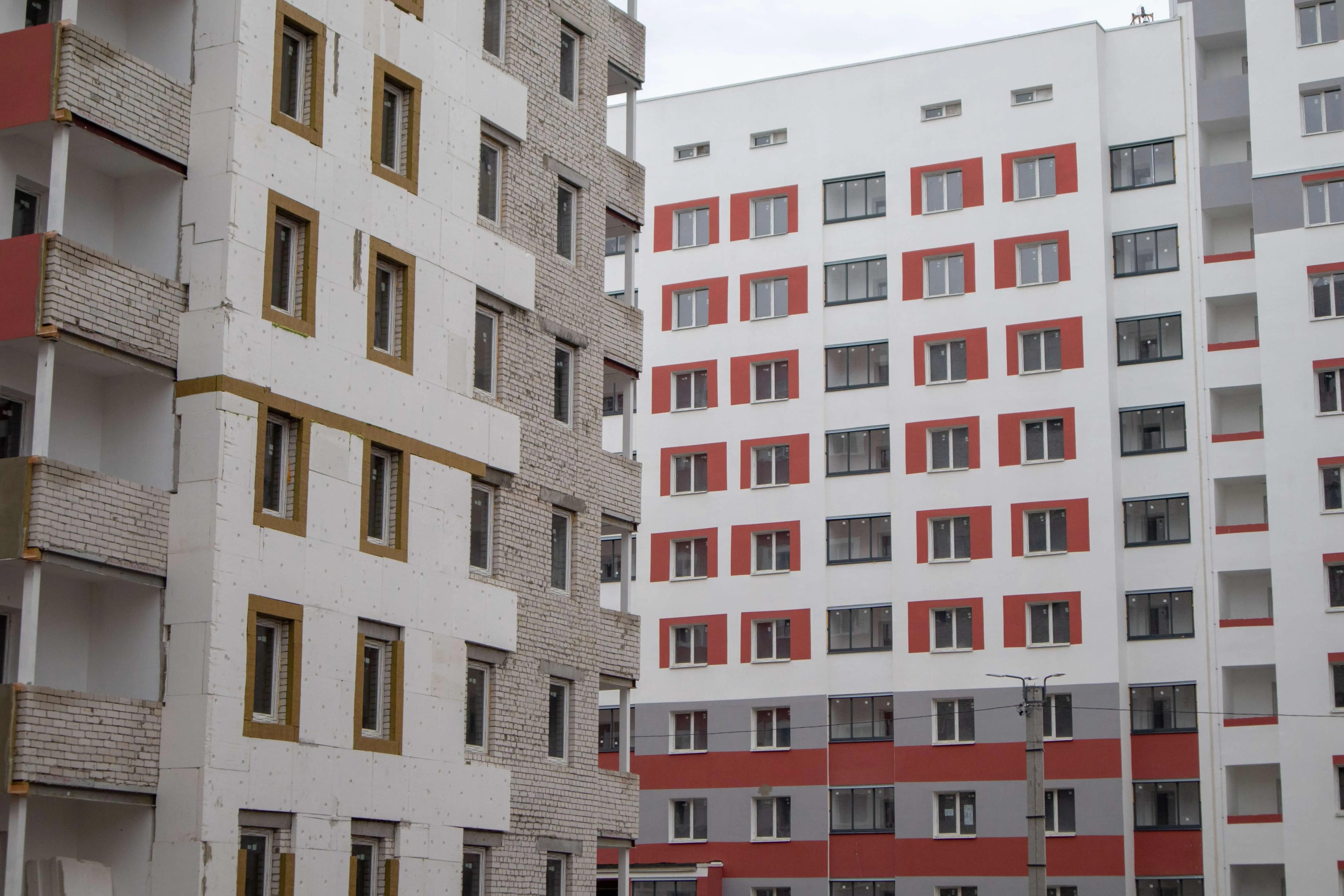
Imagine this: you bought an apartment in a beautiful complex featuring panoramic windows, a ventilated porcelain tile facade, and a closed landscaped courtyard. At hand-over, you see ordinary plaster, cheap plastic windows, and asphalt instead of greenery. Can you sue the developer?
If you signed a standard contract—no, you cannot.
“The Seller reserves the exclusive right, without the Buyer’s prior consent, to make amendments to project documentation, alter the facade, architectural solutions, balcony/loggia configurations, as well as modify the quality of materials and land landscaping.”
Developers insert these clauses to protect themselves against inflation and rising material costs. If construction becomes more expensive, the developer simply rewrites the project, uses cheaper materials, and delivers a simplified building, while you legally consented to this upon signing.
Part 4. Onerous Renovation Clauses: Blackmail over Keys
This is an absurd clause that we, as a renovation company, encounter in certain specific Housing Cooperatives (especially prevalent in certain coastal developer projects).
“The Buyer undertakes to complete the full scope of finishing/renovation works in the apartment within 3 (three) months from the date the building is commissioned. Until renovations are fully completed, ownership rights and property documents shall not be handed over.”
- How this blackmail works:
- The building is handed over, but property title documents are withheld; you are only given a "renovation access permit".
- You are given a strict ultimatum: you have exactly 90 days to complete a FULL renovation.
- If you fail to finish the renovation in 3 months—the developer reserves the right to unilaterally terminate the contract, repossess the apartment, retain a 10% penalty fee, and take up to 1 year to refund your remaining balance!
Part 5. Imposed Property Management and Utility Bills for Empty Apartments
- Utility Fees BEFORE Receiving Keys: Developers often insert clauses stating you must pay maintenance and utility fees starting from the 2nd month after the building is commissioned, regardless of whether you received your keys or actually live there.
- Captive Management Company: The contract forces you to sign an agreement with a specific property management company selected by the developer, featuring inflated maintenance rates.
- Access Pass Blocking: For utility debts or unapproved renovations, the management company can simply block your electronic access card to the entrance, elevators, and complex grounds.
How Is This Handled in Europe? (Example: Poland)
When you purchase an apartment in Poland (e.g., from a major developer like ROBYG), the contract is signed before a notary under the strict Special Developer Act (Ustawa Deweloperska):
- Escrow Accounts (Rachunek Powierniczy): Money stays safely in a bank. The bank releases funds to the developer stage-by-stage—only after a bank inspector verifies physical completion of each construction stage.
- Strict Area Tolerance (±2%): If the final measured area differs by more than 2%, the buyer has the legal right to cancel the contract and receive 100% of their money back without any penalties.
- Land Register Entry (Księga Wieczysta): The transaction is immediately registered in the official public state register, making double sales impossible.
- No Renovation Coercion: The developer hands over the property in Stan Deweloperski (shell & core state), and you can renovate it at your own pace—no one has the right to repossess your property.
Comparative Table: Ukrainian vs Polish Developers
To summarize everything mentioned above, we prepared a clear comparative table of real estate market regulations:
| Parameter / Feature | Ukrainian Developers (Cooperatives / Property Rights) | Polish Developer (Umowa Deweloperska) |
|---|---|---|
| Financing Scheme & Fund Protection | Money is transferred directly to the developer, cooperative, or venture fund. The buyer bears the risk of delays or developer bankruptcy. | Mandatory Bank Escrow Account (Rachunek Powierniczy). The bank releases funds in stages only after independent inspector verification. Additionally protected by the Developer Guarantee Fund (DFG). |
| Currency & Price Indexation | Price is almost always tied to USD. If the local currency falls, installment payments increase for the buyer. | Fixed price in PLN. Price indexation due to inflation is explicitly prohibited by contract. The only risk is state VAT rate statutory changes. |
| Area Tolerances & Measurement Standards | Permissible deviations of 3–4% or up to 5 sq. m. Extra area is billed in USD, while refunds for missing area are often made at historic rates. | Measurements follow the strict PN-ISO 9836 standard. Area changes exceeding ±2.0% grant the buyer the right to cancel the contract penalty-free. |
| Refund Terms Upon Termination | Funds are frozen for up to 1 year or "until the apartment is resold to a new buyer". Penalties of 10–15% are retained. | Refunds by the bank/developer are completed within 30 days to the designated account. Penalties are capped by law (~4.5%). |
| State Regulation | Cooperative contracts explicitly state an opt-out from special laws protecting primary real estate investors. | The agreement is drafted strictly under the Developer Protection Act (Ustawa Deweloperska) as an official notary deed. |
| Property Rights Registration During Construction | The buyer receives only a paper claim right or a "cooperative member" status. | The buyer's property transfer claim is officially entered by a notary into the Land and Mortgage Register (Księga Wieczysta), preventing double sales. |
| Onerous Renovation Requirements | Some cooperatives force renovations within 3 months under threat of property repossession and a 10% fine. | None. Developers have no right to require renovation completion within any timeframe for property title transfer. |
| Handover Delay Liability | Developers set symbolic fines for themselves (e.g., ~$12/month or 0.01%). | Statutory daily default interest (Odsetki ustawowe) or contractual fines (e.g., 4.5%) are paid to the buyer. |
Pre-Purchase Checklist: How to Protect Yourself?
- Check the termination clause: Ensure penalties are calculated based on the amount actually paid so far, not the total property price!
- Demand clear refund timelines: Require a fixed refund period (e.g., 30–60 days) and remove any clause tying refunds to apartment resales.
- Balance measurement terms: Refunds for missing square meters must be calculated at current market exchange rates.
- Remove mandatory renovation deadlines: You are under no obligation to complete renovations within 90 days.
- Review the floor plan with renovation experts: Show the floor plan to builders prior to signing to check load-bearing walls, wet zones, and electrical capacity.